This article may contain affiliate links. If you buy through them we may earn a commission at no extra cost to you.
Most C-shaped neck pillows are useless unless you have a window seat and a headrest to lean against. After testing five pillow types on flights ranging from 6 to 11 hours, we found that the right choice depends almost entirely on your seat position and how you naturally fall asleep—not on which pillow has the most Amazon reviews.
Neck Pillows: The Traditional Choice (With Caveats)
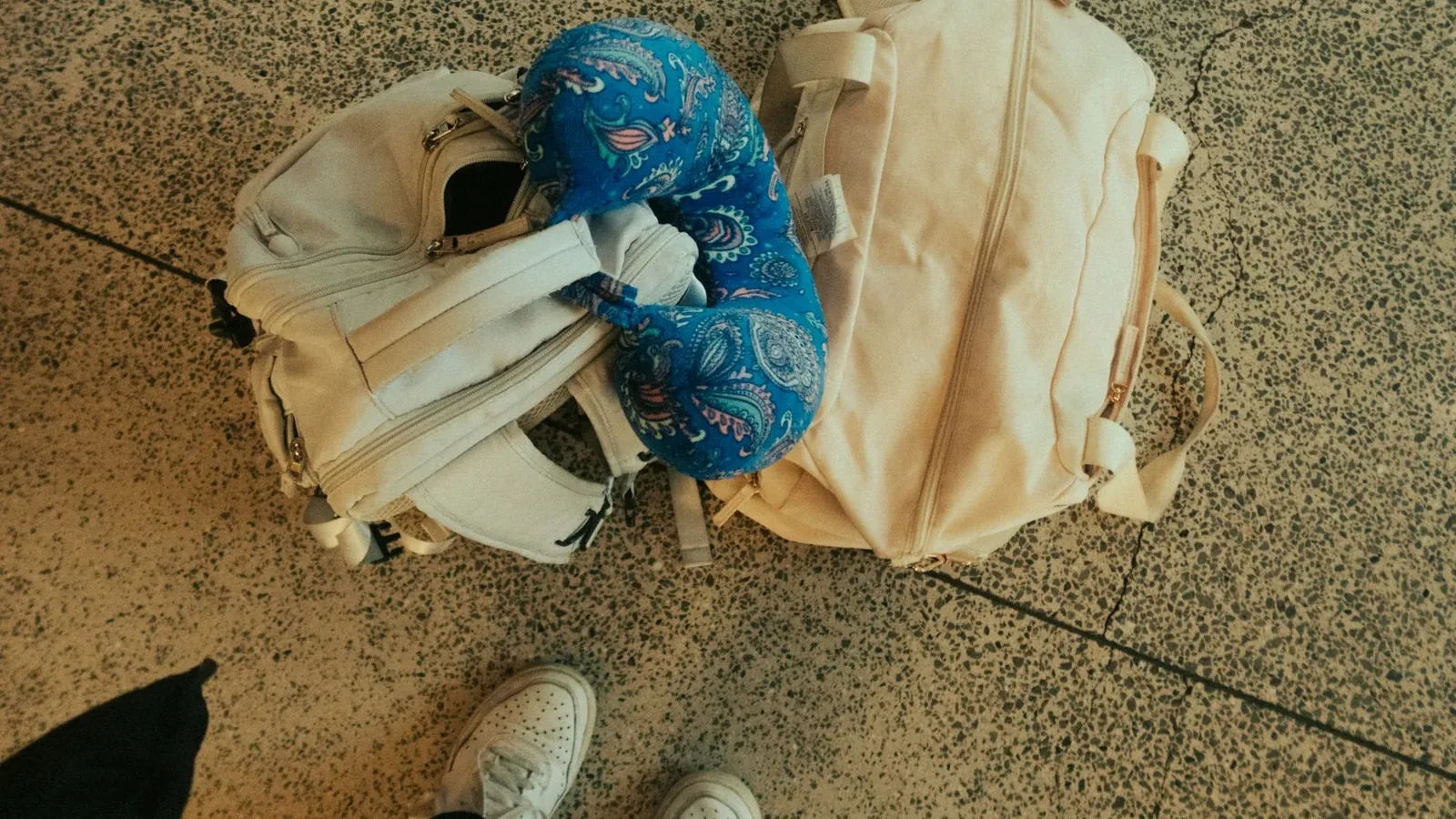
The C-shaped memory foam pillow is everywhere for a reason: it’s compact, costs $15–$40, and requires zero setup. For side sleepers in a window seat, it does its job—propping your head at an angle and preventing the forward-jolt that wakes you up every 20 minutes.
What works
- Fits in a backpack side pocket or clips to a carry-on handle
- Memory foam versions ($25–$40) sleep cooler than polyester fills
- Nothing to adjust or inflate once you’re seated
The honest trade-off
Standard 4-inch thickness doesn’t provide enough support if you’re over 5’10″—your head still tilts forward. Memory foam also takes 15–20 minutes to soften on a cold plane, which matters during boarding when you want to sleep immediately. And in a middle seat with no wall to lean against, a neck pillow does almost nothing.
Best for: Window-seat sleepers, flights under 4 hours, travelers packing light.
Not for: Middle-seat passengers, tall travelers, anyone who needs to recline deeply.
Inflatable Pillows: Lightweight and Adjustable
The appeal is practical: inflatables pack down to the size of a water bottle and cost $12–$30. Inflated to about 70% capacity—softer than instinct suggests—they work surprisingly well for side sleeping.
Real performance
On a transatlantic flight, we had one deflate to half pressure somewhere over the Atlantic. It wasn’t catastrophic, but it was annoying enough that we switched to a jacket. Pump models ($20–$35) are worth the extra cost; manually inflating a pillow in a full economy cabin is awkward for everyone nearby. The other persistent issue: the vinyl surface is cold to the touch and can shift during sleep if you move much.
Best for: Frequent travelers who pack light, side sleepers, first-time buyers who want a low-stakes experiment.
Not for: Back sleepers, anyone anxious about mid-flight equipment failures, flights over 12 hours.
Full-Size Compressible Pillows: The Comfort Argument
A small compressible travel pillow ($25–$60) provides more head and neck support than any neck pillow we tested—the contact surface is simply larger. On a red-eye where you’re paying for extra legroom, that difference is real.
The space problem
These take up a meaningful portion of a carry-on, and positioning one in economy without encroaching on your neighbor requires some creativity. Compression bags help with packing but add setup time at the gate. We found them most practical for premium cabin passengers or anyone already traveling with a checked bag—not carry-on-only trips.
Best for: Premium cabin passengers, travelers with specific neck issues, anyone not constrained by bag space.
Not for: Economy carry-on travelers, budget trips, anyone who values fast boarding.
Lumbar Supports and Wedges: Underrated Alternatives

A $20–$35 lumbar pillow addresses the root problem that neck pillows ignore: when your lower back slouches into an economy seat, your entire spine curves forward, pulling your head with it. Support the lumbar and your head stays upright without any neck pillow at all.
We found this approach more effective for sleeping upright than neck pillows alone—and it doubles as back support during a 3-hour work session. The trade-off is that it occupies the space between your back and the seat, which can feel confining on narrow economy seats. Side sleepers won’t get much from it.
Best for: People who sleep sitting up, anyone with lower back pain, travelers who want one item that serves multiple purposes.
Not for: Side sleepers, those with limited seat depth, travelers already using a neck pillow.
The best travel pillow is the one you’ll actually use, which usually means something that doesn’t feel like a novelty in your luggage.
Premium Options Worth Considering
We tested pillows from Cabeau and Travelrest in the $60–$120 range. Both use memory foam with cooling gel, fold more compactly than standard C-pillows, and include straps that anchor the pillow to the seat—which matters when turbulence hits. The straps alone justify some of the price premium; a pillow that stays in place during sleep is meaningfully better than one you’re repositioning every hour.
That said, the jump from a $25 pillow to a $70 one buys you roughly 30% more comfort, not double. The diminishing returns are real above $80.
Worth it if: You fly four or more times per year, cheaper pillows have already failed you, or you have neck or shoulder issues that make bad sleep genuinely costly.
Skip if: You fly once or twice a year, you sleep easily on planes regardless, or you haven’t yet confirmed you’ll use a travel pillow at all.
Comparison Table
| Pillow Type | Price Range | Pack Size | Best Sleep Position | Durability | Setup Time |
|---|---|---|---|---|---|
| Neck Pillow (Memory Foam) | $20–$40 | Small | Side/Window | 2–3 years | None |
| Inflatable Pillow | $12–$35 | Very Small | Side | 1–2 years | 2–5 min |
| Full-Size Compressible | $25–$60 | Large | Any | 3–5 years | None |
| Lumbar Support | $20–$40 | Medium | Upright | 2–4 years | None |
| Premium Travel Pillow | $60–$120 | Small | Side/Upright | 3–5 years | 1 min |
Our verdict
Window-seat side sleepers: a mid-range memory foam neck pillow at $25–$35 is the practical call. Frequent flyers who end up in any seat: a premium strapped pillow at $70–$100 earns its cost over a year of better sleep. Middle-seat passengers and upright sleepers: skip the neck pillow entirely and spend $25–$35 on a lumbar support. If you’ve never used a travel pillow and aren’t sure you will, start with a $15–$20 inflatable—low enough stakes that a jacket rolled against the window is still a valid backup. For longer international routes, our international flight tips guide covers sleep strategies beyond pillows.
What We Didn’t Recommend
Neck pillows under $10 flatten after a few flights and offer almost no support once they do. Novelty designs—animal shapes, airline-branded versions—are uncomfortable in practice. Sleeping masks with built-in pillow sections are awkward to reposition mid-flight and don’t support your neck meaningfully. None of these made our list.
Frequently asked questions
Do travel pillows actually help you sleep on planes?
It depends on the pillow and your sleeping style. A good neck pillow helps side sleepers and window-seat passengers stay comfortable for 2–4 hours by preventing the forward head-jolt that breaks light sleep. Back sleepers often find them useless. The benefit is about maintaining position, not inducing deeper sleep.
What’s the difference between memory foam and polyester travel pillows?
Memory foam holds its shape longer, provides firmer support, and sleeps cooler—especially gel-infused versions. Polyester is lighter, cheaper, and soft from the moment you put it on. Memory foam takes 15–20 minutes to soften on a cold plane. For most travelers, the $25–$30 memory foam option is worth the step up from $12 polyester.
Can I bring a travel pillow through airport security?
Yes. Pillows are permitted in carry-on and checked bags with no TSA restrictions. Inflatable pillows are fine deflated through the checkpoint—inflate after security. Gel-filled pillows are also allowed.
How do I clean a travel pillow?
Most memory foam neck pillows have removable covers that are machine-washable—check the tag before you assume. For the foam core, spot-clean with a damp cloth and air-dry for at least 24 hours before packing. Inflatable pillows wipe down with a damp cloth. Washing the cover every 5–10 flights is enough for most travelers.
Is a travel pillow worth buying if I only fly once a year?
Not a premium one. A $15–$20 inflatable is a reasonable experiment—if you don’t use it, the loss is small. Many occasional flyers find a jacket rolled against the window works just as well. Once you know your sleeping habits on planes, then consider spending more.

Maya has spent twelve years writing about travel, from budget backpacking to family resorts, and still packs too many socks.